Why I Don’t Use Synthetic Fertilizers on My Houseplants
Hello gardeners!
Indoor gardening has a funny contradiction at its core. We take care of indoor houseplants for the beauty, calm, and connection to nature. Then we often manage them with highly industrial inputs. Synthetic fertilizers are widely recommended for houseplants because they’re effective, predictable, and easy. And to be clear: the products are not inherently toxic, nor do they immediately harm plants. But over time, I’ve chosen not to use them indoors. Not out of fear, but out of philosophy.
Indoor POTTING soil is already a simplified system
Most houseplant potting mixes are designed for drainage and consistency, not ecology. They are typically sterile, meaning there is very little microbial life present. Because of this, it may seem like using synthetic fertilizers is benign as there is nothing alive to disrupt.
But the absence of microbial life matters.
Plants have evolved to grow within living systems, exchanging sugars for nutrients through fungi and bacteria. When we feed plants with immediately soluble nutrients, we bypass those natural processes entirely. The plant growth becomes too fast, too soft and too dependent on this input.
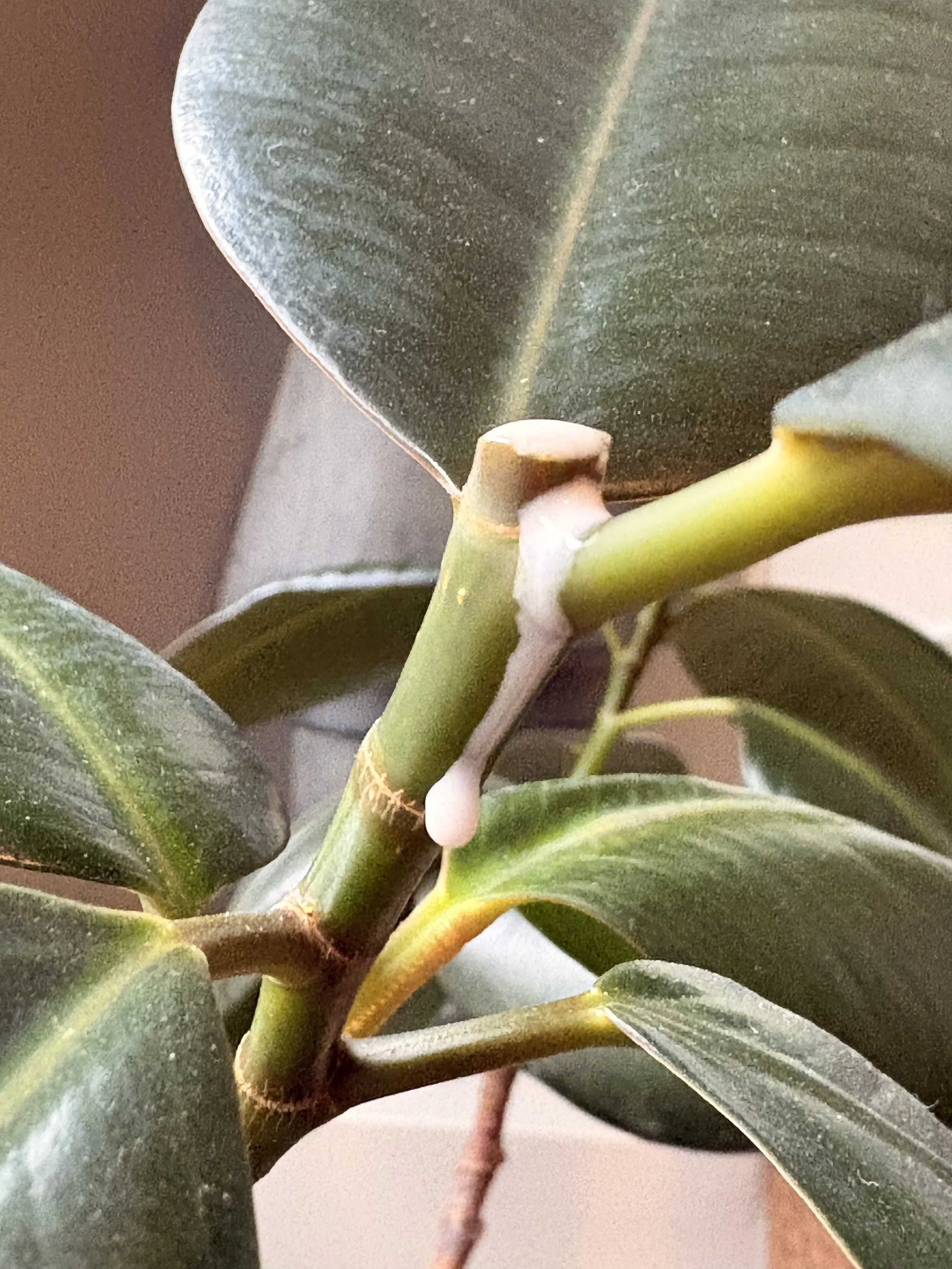
Photo: R. Pak
I was pinching back a small rubber plant (Ficus elastica) and the flow of the milky white fluid (latex) reminded me how wonderful nature is. A built in defense mechanism.
Fertilizer trains houseplants how to grow
Synthetic fertilizers deliver nutrients in a form that requires very little effort from the plant. Over time, this can lead to:
rapid, lush top growth with weaker structure
reduced root development
lower tolerance for light shifts, dryness, or stress
For me this weakened resilience is critical. Life gets busy, we miss a watering or two, or forget to drop the blinds on a hot day. Suddenly, the plant is collapsing.
That’s not a failure of care. It’s a lack of resilience.
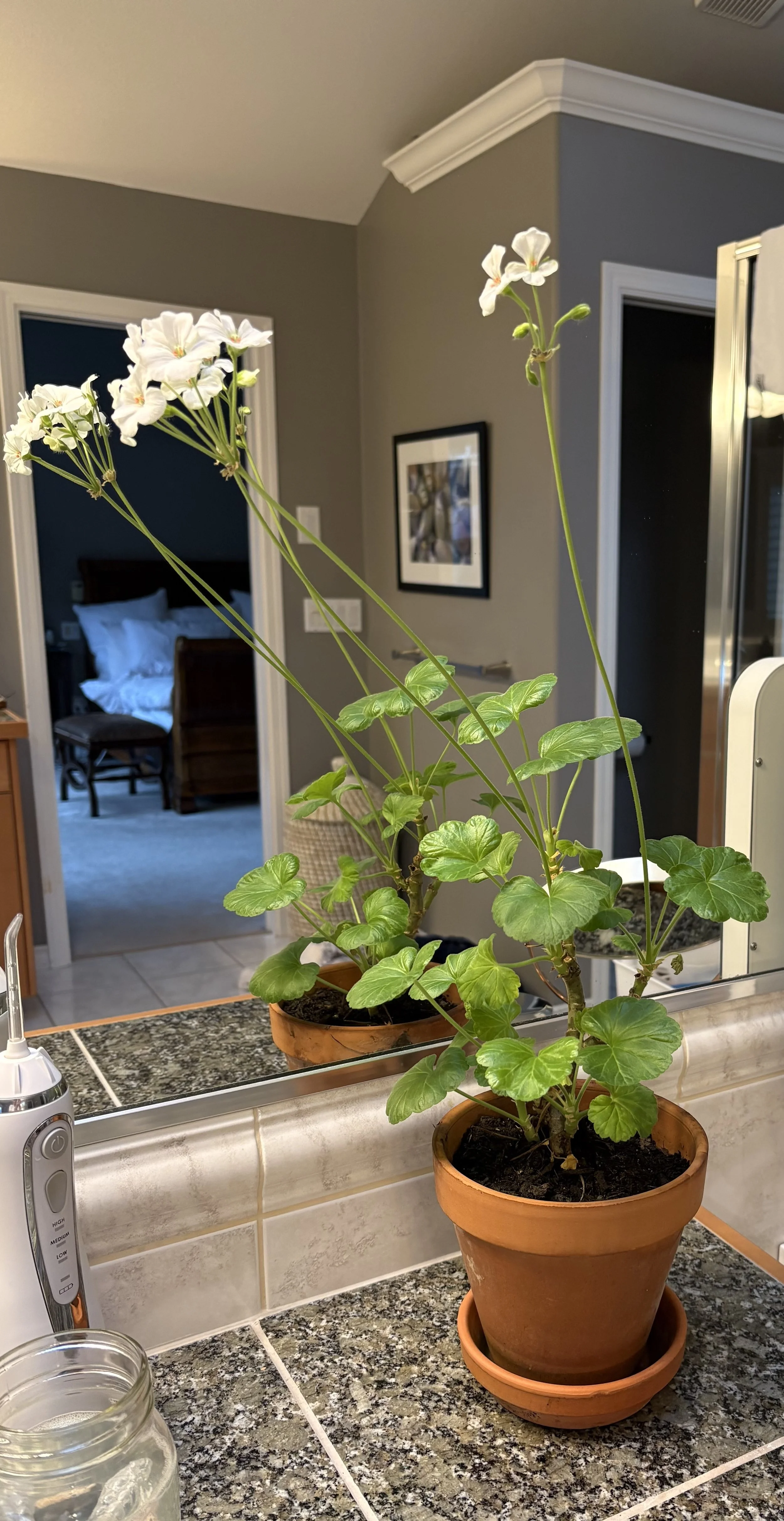
Photo by: R. Pak
This geranium was left outside and was still green after Christmas. I brought it into the bathroom where there is a bright skylight. It is blooming and lovely, but it is not strong and resilient. The stems are leggy and if this was outdoors the foliage would be much darker. I love it anyway but before it goes outside I will likely cut it back quite a bit.
Salt buildup is real in pots
Most synthetic fertilizers are salt based. Outdoors, rain flushes excess salts through soil. Indoors, that flushing rarely happens unless we do it intentionally, and it is a messy task indoors.
Over time, salts accumulate in the potting mix, making it harder for roots to absorb water. This is why leaf tip burn, crusty soil surfaces, and unexplained decline are so common in houseplants that are “fed regularly.”
The environmental cost doesn’t disappear indoors
Even if indoor fertilizers aren’t contributing to runoff or groundwater contamination, their environmental footprint still exists. Synthetic fertilizers are energy-intensive to produce and heavily tied to fossil fuels. Choosing not to use them indoors is a values-based decision—one that acknowledges that our houseplants are still connected to global systems.
What I do instead
I favour slow, gentle inputs:
worm castings as a top dressing
seasoil as a top dressing
(I like the richness compared to potting mix, but remain burdened by the plastic, transport)
occasional, very diluted compost tea
This doesn’t force growth. It supports balance and resilience.
Remember houseplants don’t need to grow fast. Part of their job is to simply bring nature indoors so we can all breathe easier.
Next week, I’ll explore one of the most effective—and often overlooked—ways to build that plant resilience: moving houseplants outdoors in the summer.