Do Eco-Conscious Gardens Need Fertilizer? The Answer Isn't Black and White
Hello gardeners!
A few years ago I stopped using fertilizer altogether. I wanted to garden more lightly, reduce unnecessary inputs and let healthy soil do more of the work. For shrubs, trees and established perennials, the results were encouraging. But my containers told a different story.
My trees and shrubs look healthy. The soil beneath the mulch is becoming darker in some areas now. From my perspective this darker colour shows the soil has more organic matter and is holding moisture effectively.
What I am noticing is that the summer flower display is not as spectacular as I hoped it would be.
Many perennials are blooming less generously, and the containers I have with tender perennials or annuals are growing but with less abundant flowers. In the Vancouver, BC area we usually have only a couple of months of hot summer, so I enjoy the profusion of vibrant colour from the hanging baskets I make and the overflowing containers of annuals.
Have I swung too far in the opposite direction?
I am wondering if perhaps the question is not whether we fertilize or not, but how should we fertilize.
Nature Does Not Grow in Containers
In a woodland or prairie, plants live in a remarkably efficient recycling system built on fallen leaves decomposing, microorganisms breaking down organic matter and a fungi network building strong root networks. Nutrients are continually returned to the soil.
Containers are completely different.
Containers for the most part are closed systems. I hesitate to say they are closed systems because there are so many types of containers for planting and many are used directly in the garden soil, so there could be drainage directly into the garden soil.
Potting soil mixes (even good quality ones) do not contain or host the diverse microbial life found in garden soil, and annual flowers or tender perennials are bred to produce an astonishing number of blooms in a single season. This makes flowering plants heavy feeders. Expecting hanging baskets or containers to thrive all summer without supplemental nutrition may have been naive on my part.
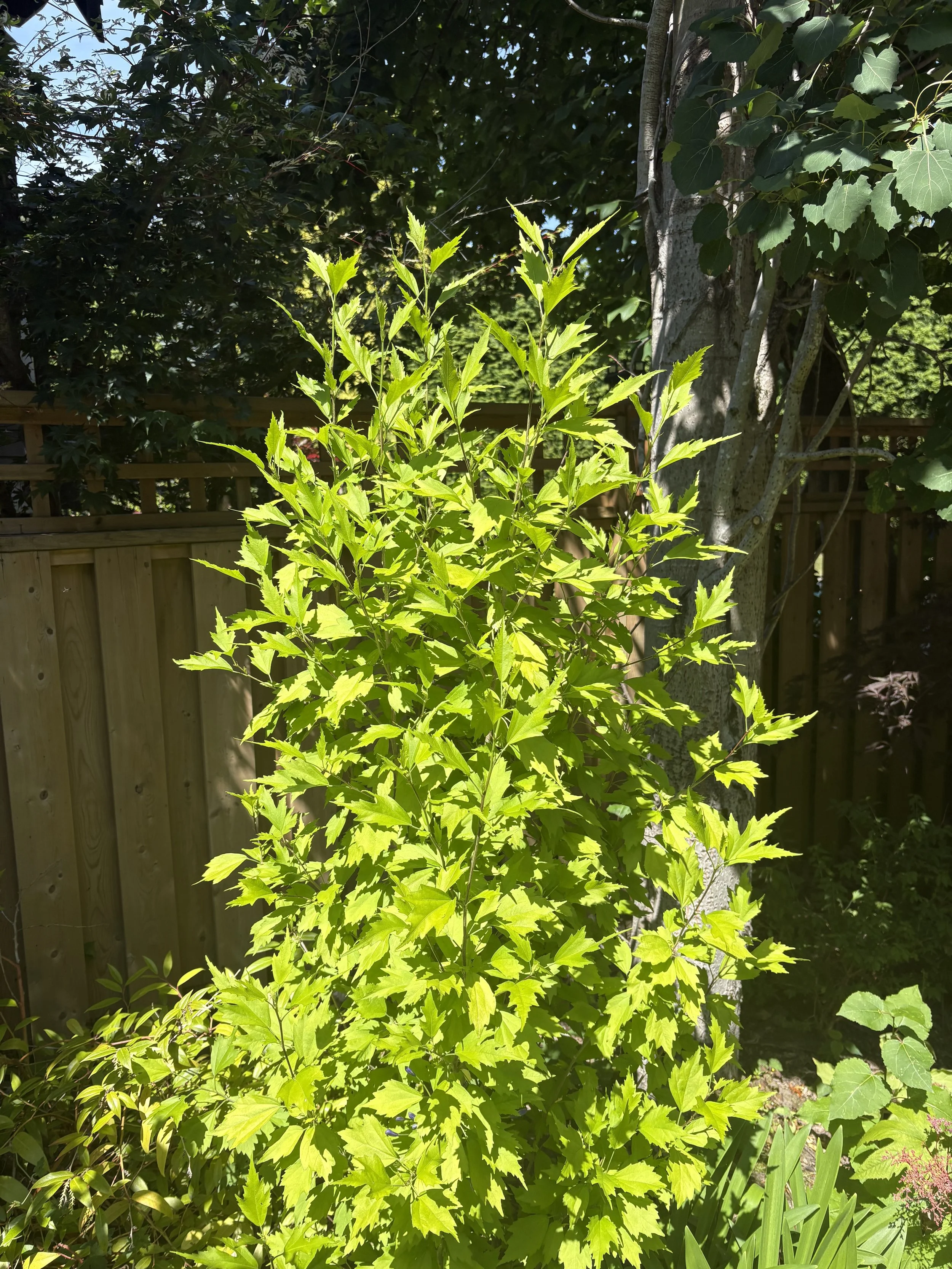
Photo Credit: R. Pak
This hardy hibiscus, despite being a young plant, is usually covered in blooms. No buds in sight. Now granted it is close to a tree, so it may be fighting for nutrients. Might need to consider a better spot for next year.
Not all Garden Plants Need the Same Diet
A mature shrub growing in rich soil has very different nutritional needs than a container. Another example would be dahlias grown in the garden soil. They generally still need added fertilizer to get the heavy blooms gardeners desire.
Many established perennials perform better without excessive fertilizer. Too much nitrogen often produces lush foliage at the expense of flowers. All those fresh young leaves can also leave plants susceptible to pests and disease.
Heavy flowering plants, however, remove significant amounts of nutrients from the soil every season. If those nutrients are not replaced over time, flowering may gradually decline even when the plant appears healthy. I suspect this is what I am noticing in my own garden.
This is where observation becomes more important than routine. Rather than feeding every plant on a schedule, ask what the plant is telling you. Has overall growth slowed? Are leaves pale despite proper watering? Is the plant flowering less than expected? Fertilizer should be considered in response to a plant's needs, not simply the calendar or traditional rules of fertilize annuals weekly.
What Eco-Conscious Gardeners Should Avoid
Being environmentally responsible does not necessarily mean avoiding fertilizer altogether. When possible, avoid high-nitrogen synthetic fertilizers that force rapid, soft growth.
Look at the nutrient source on fertilizers you buy. The ingredient list is usually more informative than the marketing.
If you see ingredients such as:
Urea
Ammonium sulfate
Ammonium nitrate
Ammonium phosphate
Calcium nitrate
Potassium chloride (muriate of potash)
Monoammonium phosphate (MAP)
Diammonium phosphate (DAP)
the fertilizer is primarily synthetic or contains synthetic nutrients.
These ingredients are manufactured to provide nutrients in a highly soluble, immediately available form.
Common natural or organic nutrient sources should include ingredients like:
Compost
Composted poultry manure
Feather meal
Bone meal
Blood meal
Fish meal
Fish hydrolysate
Kelp meal
Alfalfa meal
Soybean meal
Worm castings
Rock phosphate
Greensand
These come from plant, animal or naturally occurring mineral sources.
Five clues you're looking at a synthetic fertilizer:
The ingredient list includes urea or ammonium-based nutrients
The fertilizer promises rapid or instant results
Nutrients are described as immediately available or water soluble
There is no organic certification or mention of natural ingredients
The product emphasizes feeding the plant but says little about improving soil
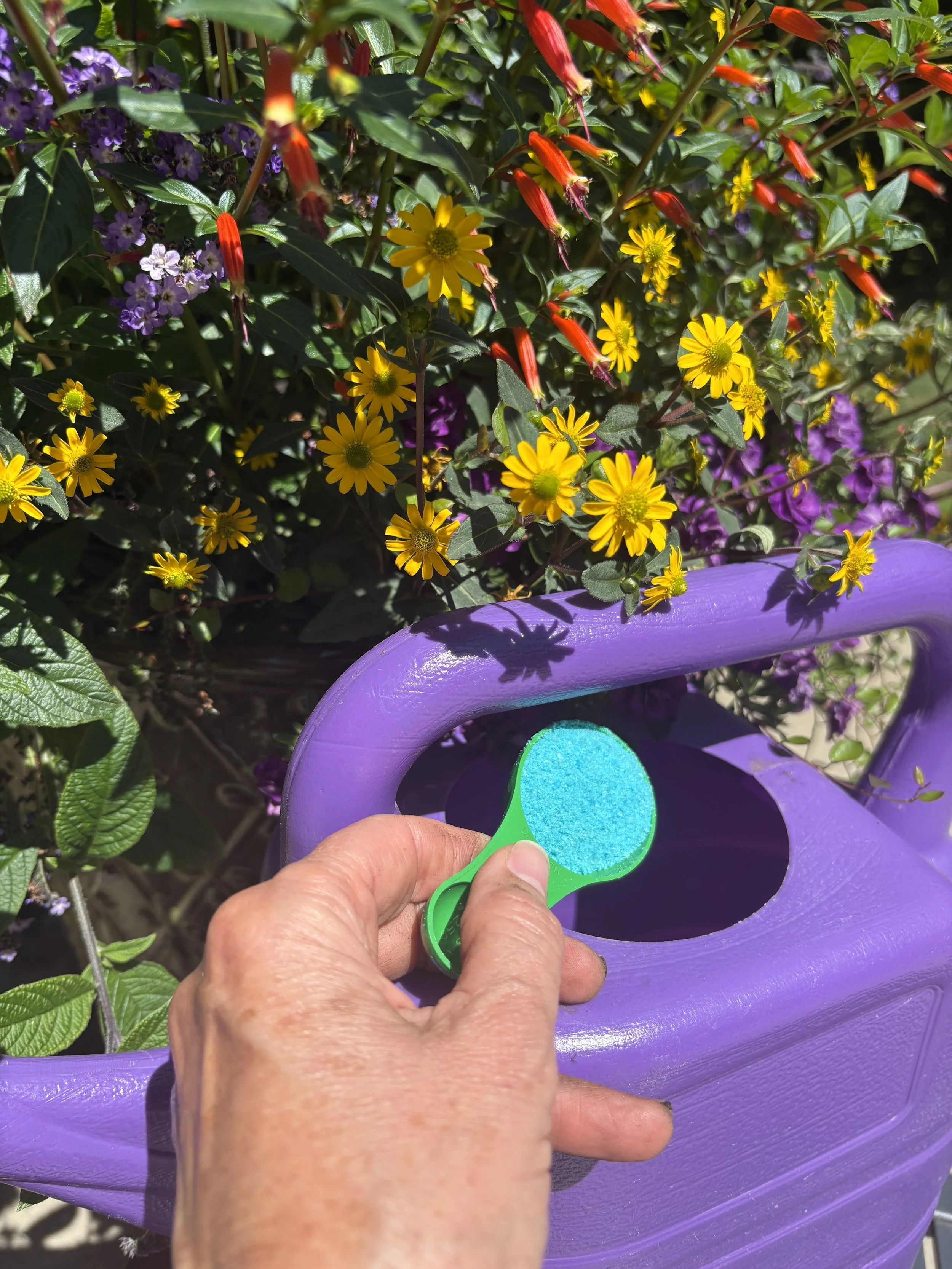
Photo Credit: R. Pak
What I have done
For the Patio Containers:
I have decided after much consideration to use a synthetic fertilizer that is water soluble. I am going to use it twice in the summer season for my hanging baskets and containers only. Just to get the bump in flower production I am seeking. My pots leach very little. Seldom do I see any moisture around the base of the pot. I know the fertilizer is not making its way into the garden beds where it can disturb the microbials in the soil. Secondly, the soil I use in containers is reused in containers each year. I do not add it to the garden beds. I take the soil out of the containers and add a fresh bag of sea soil or other premium soil mix to refresh the soil, then repot the containers. The same goes for my moss hanging baskets. I reuse the moss which originates in my garden, each year, with the addition of some moss as needed to patch up areas of the basket frame. This way I feel like I am minimizing inputs by reusing materials, but I can still get the flower power I desire. Intentional compromise.
For the Garden:
I am asking what is the plant missing that results in the flowers being less abundant. Has that part of the garden got less water than normal? Is the plant getting more shade than previous years due to tree growth in the area? Do I need to do more to enrich the soil in a particular area. My choice is to not add unnecessary synthetic fertilizers to my garden soil directly. I am going to consider adding an organic fertilizer to the plant to see if that creates a short-term improvement in flowering. In the fall I will transplant perennials that are not flowering to a different part of the garden to see if they flourish elsewhere. I have not tried a granular kelp fertilizer, but I am going to add it to an area of the garden to see if the kelp supports increased microbial activity, thereby enriching the soil. Come the fall, I am going to combine the leaf matter from different trees. In some areas of the garden, I may have too many large magnolia leaves that do decompose quickly enough. I like them for protection against heavy rains, but I think I should mix in different leaves to optimize the nutrients from the decomposition. Something to consider for my fall garden 'to do' list.
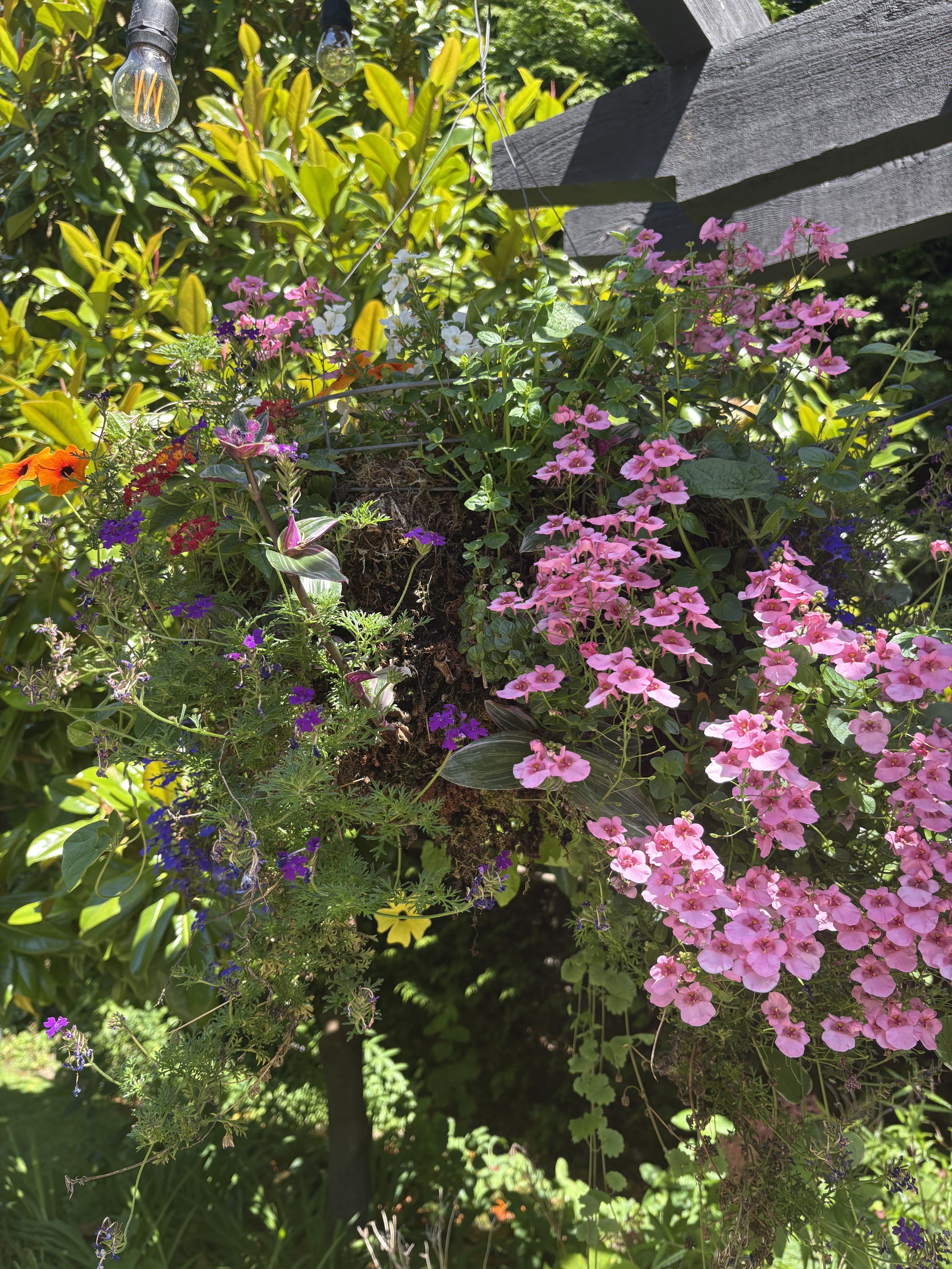
Photo Credit: R. Pak
Normally my homemade hanging baskets are covered in blooms. This year I find the baskets have fewer blooms. Same spot, same water regime, no fertilizer.
Remember...
The most sustainable garden isn't necessarily the one with the smallest footprint. It's the one that encourages gardeners to keep gardening.
That doesn't mean environmental impact doesn't matter—it absolutely does. But if we set the bar at ecological perfection, many gardeners will simply disengage because the ideal feels unattainable. I believe gardens are an important part of the pathway necessary to support the rebuilding of local biodiversity. Losing potential gardens and gardeners does not move the needle forward.
My goal isn't to create a perfect garden with no environmental footprint. I cannot see a way forward that makes that attainable. Every decision has trade-offs. My goal is to become more informed and garden more thoughtfully each year, reducing unnecessary inputs while still creating a garden I love.
That's a balance I'll continue refining as both my garden and our climate continue to change.